
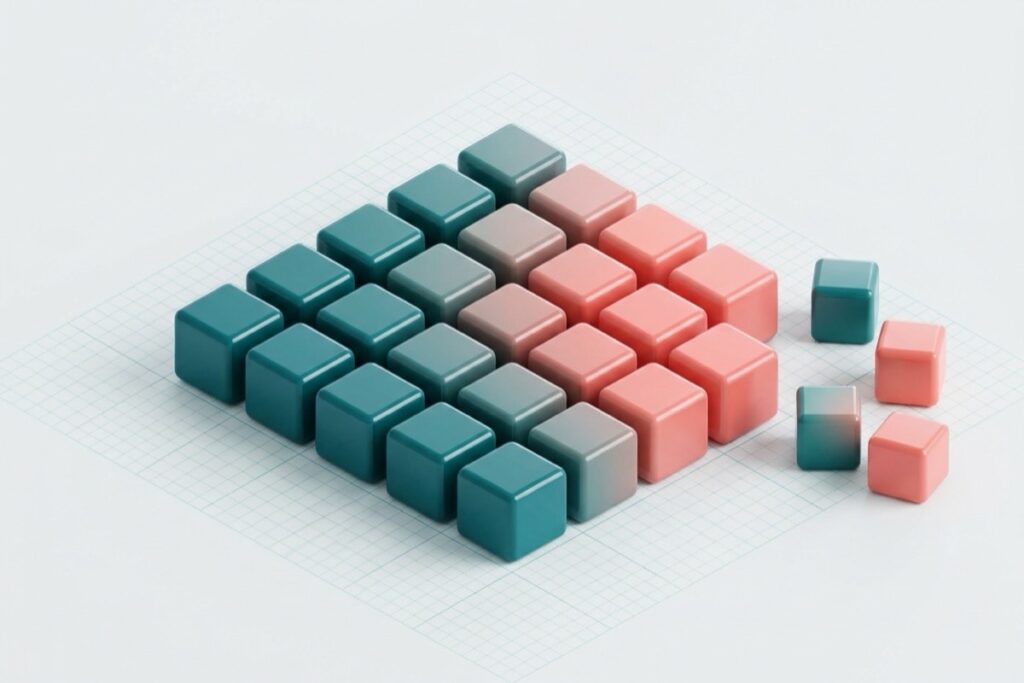
The square of a number is the number multiplied by itself. Squares show up in geometry, area calculations and many maths tricks. Knowing how to find them in your head is a great mental math skill.
Below is a list of squares to memorize, followed by four fast tricks for squaring bigger numbers.
Squares to Know by Heart
Memorizing squares up to 20 gives you a reliable base for everything else.
- 1² = 1, 2² = 4, 3² = 9, 4² = 16, 5² = 25
- 6² = 36, 7² = 49, 8² = 64, 9² = 81, 10² = 100
- 11² = 121, 12² = 144, 13² = 169, 14² = 196, 15² = 225
- 16² = 256, 17² = 289, 18² = 324, 19² = 361, 20² = 400
Most of these come from your times tables. See our times tables chart for 1 to 12.
Trick 1: Numbers Ending in 5
Take the digit(s) before the 5, multiply by the next number up, and put 25 on the end.
- 35²: 3 × 4 = 12, so the answer is 1,225.
- 65²: 6 × 7 = 42, so the answer is 4,225.
- 85²: 8 × 9 = 72, so the answer is 7,225.
- 105²: 10 × 11 = 110, so the answer is 11,025.
Trick 2: Split Into Tens and Units
Write the number as tens plus units, then use (a + b)² = a² + 2ab + b².
- 23²: 20² = 400, 2 × 20 × 3 = 120, 3² = 9. Total: 400 + 120 + 9 = 529.
- 31²: 900 + 60 + 1 = 961.
- 46²: 1,600 + 480 + 36 = 2,116.
Trick 3: Numbers Near 50
Use 50² = 2,500 as an anchor, then adjust.
- 52²: 2,500 + (2 × 50 × 2) + 4 = 2,500 + 200 + 4 = 2,704.
- 48²: 2,500 − 200 + 4 = 2,304.
- 53²: 2,500 + 300 + 9 = 2,809.
The same idea works with any round number as an anchor, such as 100² = 10,000 for numbers near 100:
- 97²: 10,000 − (2 × 100 × 3) + 9 = 10,000 − 600 + 9 = 9,409.
- 102²: 10,000 + 400 + 4 = 10,404.
Trick 4: The Difference Method
To square a number, move a little up and a little down to make it easier, then add back the square of the gap.
For 47²: 47 is 3 less than 50. Take 44 × 50 = 2,200, then add 3² = 9. The answer is 2,209.
In general, n² = (n − k)(n + k) + k². Pick k so that one of the factors is a round number.
A Useful Pattern
Each square is the previous square plus an odd number: n² = (n − 1)² + (2n − 1). For example, 31² = 30² + 61 = 900 + 61 = 961.
Why They Are Called Squares
A square number is the number of small squares in a bigger square. A 7 by 7 grid has 49 small squares, so 7² = 49. Squares also grow by adding odd numbers: 1, then 1 + 3 = 4, then 4 + 5 = 9, then 9 + 7 = 16. The sum of the first five odd numbers (1 + 3 + 5 + 7 + 9) is 25, which is 5².
Square Roots: Going Backwards
The square root of a number is the one that gives it when multiplied by itself. If you know your squares, you can estimate roots quickly.
- √49 = 7 exactly.
- √50 is just over 7, because 7² = 49. It is about 7.1.
- √200 is just over 14, because 14² = 196. It is about 14.1.
Where Squares Are Useful
- Area: a square room 6 m on each side has an area of 36 square metres.
- Estimating: a number near 50 squared is close to 2,500.
- Multiplication shortcuts: many mental methods, such as the difference of squares, rely on squares.
A Second Practice Set
- 14²
- 25²
- 62²
- 89²
- 105²
Answers: 196, 625, 3,844, 7,921, 11,025
Hints: for 62², do 60² + 2 × 60 × 2 + 4 = 3,600 + 240 + 4. For 89², do 90² − 2 × 90 + 1 = 8,100 − 180 + 1. For 105², use the “ends in 5” trick: 10 × 11 = 110, then 25.
Practice Problems
- 17²
- 45²
- 53²
- 98²
- 71²
- 25²
Answers: 289, 2,025, 2,809, 9,604, 5,041, 625
Hints: for 98², use 100² − 2 × 100 × 2 + 4. For 71², use 70² + 2 × 70 + 1.
These are part of the toolkit in our 10 mental math tricks. To multiply two different numbers, see how to multiply two-digit numbers in your head.
Using Squares to Multiply
Squares unlock other multiplications. When two numbers are next to each other, n × (n + 1) is the square plus the number: 12 × 13 = 12² + 12 = 144 + 12 = 156. When two numbers are the same distance either side of a middle number, the answer is the middle square minus the gap squared: 24 × 26 = 25² − 1 = 625 − 1 = 624.
A 3-Day Plan for Learning the Squares
- Day 1: learn 1² to 10², which you probably know already from the tables.
- Day 2: learn 11² to 15², using the 11 and 12 times tables and the “ends in 5” trick for 15.
- Day 3: learn 16² to 20², then test yourself on all twenty in random order.
Common Mistakes
- Doubling instead of squaring. 7² is 49, not 14.
- Forgetting the middle term. In (20 + 3)², the middle term is 2 × 20 × 3 = 120. Skipping it gives 409 instead of 529.
- Losing the 25. When squaring a number ending in 5, remember that every answer ends in 25.
Practice With PureMath
PureMath is a mental math trainer with short multiplication exercises and times tables practice that build the speed behind these tricks. Difficulty increases as you improve, and progress tracking and a streak calendar keep you coming back each day.
Download PureMath on the App Store or try the mental math practice page.
Frequently Asked Questions
What is the fastest way to square a number?
It depends on the number. For anything ending in 5, use the “n times n+1, then 25” trick. For numbers near 50 or 100, use that value as an anchor.
How many squares should I memorize?
Squares up to 20 are enough for most people. The tricks above cover the rest.
Why is it useful to know squares?
They help with area calculations, estimating, and many multiplication shortcuts.
Does this work for decimals?
Yes. Ignore the decimal point, square the number, and put it back. 1.5² is 15² = 225 with two decimal places, which gives 2.25.
Final Thoughts
Learn the squares up to 20 and two or three of the tricks above, and you will be able to square almost any number up to 100 in a few seconds. Practice a little each day and they will soon feel natural.