
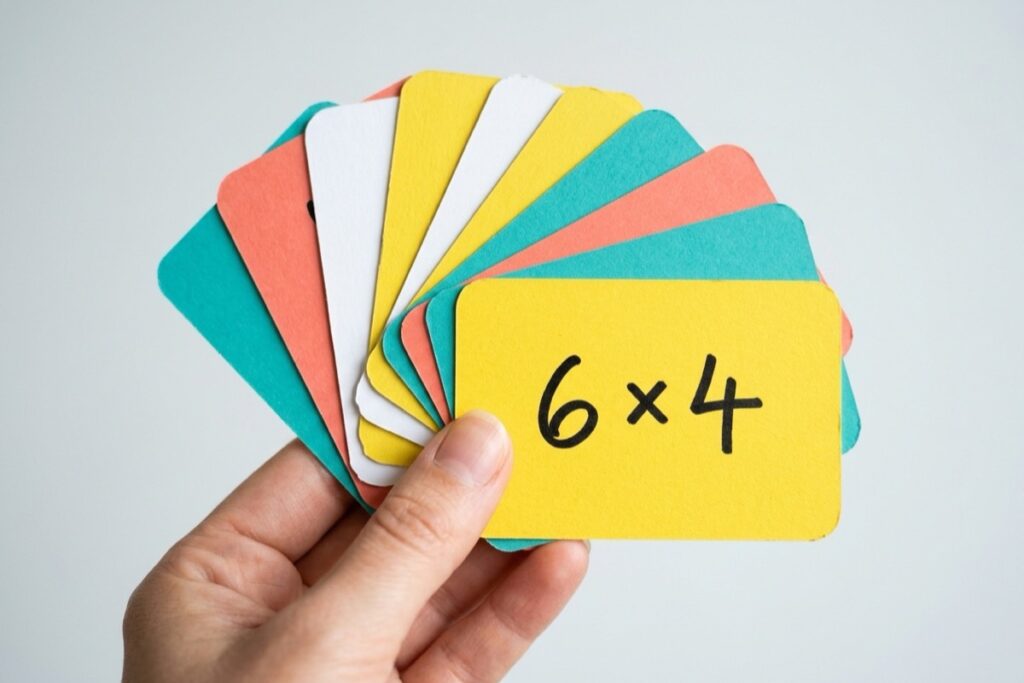
The best way to improve at mental math is to practice with real problems. Below are 30 problems in three levels, with answers at the end of each set. Cover the answers, work in your head, then check.
How to Use These Problems
- Do one set at a time, without paper or a calculator.
- First aim for accuracy. Add a timer once you are getting most right.
- Mark the ones you miss and try them again tomorrow.
- Stuck? Check the tips in our 10 mental math tricks.
Level 1: Easy
Addition, subtraction, simple multiplication and division with small numbers.
- 9 + 6
- 17 + 8
- 30 − 12
- 45 − 19
- 3 × 7
- 5 × 9
- 6 × 4
- 18 ÷ 3
- 20 ÷ 4
- 10 × 8
Answers: 1) 15, 2) 25, 3) 18, 4) 26, 5) 21, 6) 45, 7) 24, 8) 6, 9) 5, 10) 80
Level 2: Medium
Two- and three-digit numbers, the times tables up to 12, and a first percentage.
- 46 + 38
- 125 + 67
- 91 − 47
- 200 − 135
- 7 × 8
- 12 × 6
- 9 × 9
- 64 ÷ 8
- 91 ÷ 7
- 15% of 40
Answers: 1) 84, 2) 192, 3) 44, 4) 65, 5) 56, 6) 72, 7) 81, 8) 8, 9) 13, 10) 6
Hints: 91 − 47 is 91 − 50 + 3. For 15% of 40, find 10% (4) and add half of it (2).
Level 3: Hard
Bigger numbers, two-digit multiplication, remainders and decimals.
- 384 + 279
- 1,000 − 568
- 24 × 15
- 36 × 25
- 47 × 6
- 19 × 13
- 168 ÷ 12
- 250 ÷ 8
- 35% of 80
- 17²
Answers: 1) 663, 2) 432, 3) 360, 4) 900, 5) 282, 6) 247, 7) 14, 8) 31.25, 9) 28, 10) 289
Hints: 24 × 15 is 240 + 120. For 36 × 25, divide 36 by 4 and multiply by 100. For 19 × 13, do 20 × 13 − 13. For 35% of 80, add 30% (24) and 5% (4).
Bonus Level: Word Problems
Real problems come wrapped in words. Read each carefully, decide what operation is needed, then solve it in your head.
- A pack has 12 pencils. How many are in 7 packs?
- A train leaves at 14:35 and the journey takes 1 hour 50 minutes. When does it arrive?
- Tickets cost 7.50 each. What do 4 tickets cost?
- A shirt costs 40 and is 25% off. What is the sale price?
- 144 sweets are shared equally among 12 children. How many does each get?
- Three bills are 12.50, 7.25 and 4.25. What is the total?
Answers: 1) 84, 2) 16:25, 3) 30, 4) 30, 5) 12, 6) 24.00
Hints: for 2, add 1 hour to get 15:35, then 50 minutes takes you to 16:25. For 4, a quarter of 40 is 10.
Tips for Solving Fast and Accurately
- Pick a method before you start. Spend a second choosing: split, round, double, or recall.
- Say the steps silently. It keeps your place when you hold partial answers.
- Estimate first for harder problems, so you can catch big mistakes.
- Don’t skip the review. Going over the wrong answers is where most of the learning happens.
What to Do With Your Results
- 8 or more right: move up a level.
- 5 to 7 right: stay on this level and repeat the set in a few days.
- Fewer than 5: go back a level and work on the basics.
Weak spots usually come from slow recall of the tables, so use our times tables chart and the guide to the hardest times tables if they appear in your mistakes.
Level 4: A Timed Mixed Challenge
Set a timer for three minutes and try to finish all ten. Accuracy matters more than finishing, so don’t rush at the cost of mistakes.
- 14 × 6
- 250 + 375
- 81 ÷ 3
- 18% of 50
- 1,200 ÷ 40
- 7 × 13
- 305 − 178
- 22 × 5
- 9² + 4²
- a quarter of 360
Answers: 1) 84, 2) 625, 3) 27, 4) 9, 5) 30, 6) 91, 7) 127, 8) 110, 9) 97, 10) 90
A Simple Weekly Plan Using These Sets
- Monday: the Level 1 or 2 set, whichever suits you.
- Tuesday: redo the ones you got wrong on Monday.
- Wednesday: a new set at the same level.
- Thursday: a word-problem set.
- Friday: a timed mixed round.
- Weekend: make up your own problems from real life.
Write your score each day. A small notebook with the date and the number correct is all you need, and it will show your improvement over a few weeks.
Making Your Own Problems
- Use numbers on receipts, number plates and clocks.
- Roll dice or draw playing cards to make random problems.
- Change one number from a problem you already solved and solve the new version.
Practice With PureMath
Writing out new problems takes time. PureMath is a mental math trainer that provides short exercises in addition, subtraction, multiplication and division, one at a time or mixed, with difficulty that increases as you improve. It also includes times tables practice and memory games, and tracks your speed and accuracy over time, so you always have fresh practice problems.
Download PureMath on the App Store or try the mental math practice page.
Frequently Asked Questions
How many problems should I do each day?
Ten to twenty problems, or five to ten minutes, is enough for most people.
Should I time myself?
Start without a timer, then add one when you are getting most answers right.
Where do I find more problems?
Our mental math exercises for beginners has more sets with answers, and the PureMath app gives you fresh problems every session.
What if I keep getting the same ones wrong?
Write them down and practice them separately. Repeated mistakes usually point to one missing fact or method.
Final Thoughts
Steady practice with the right level of problems is what builds mental math. Work through these sets, check your answers, and repeat the ones that need it. You will see the progress within a few weeks.