
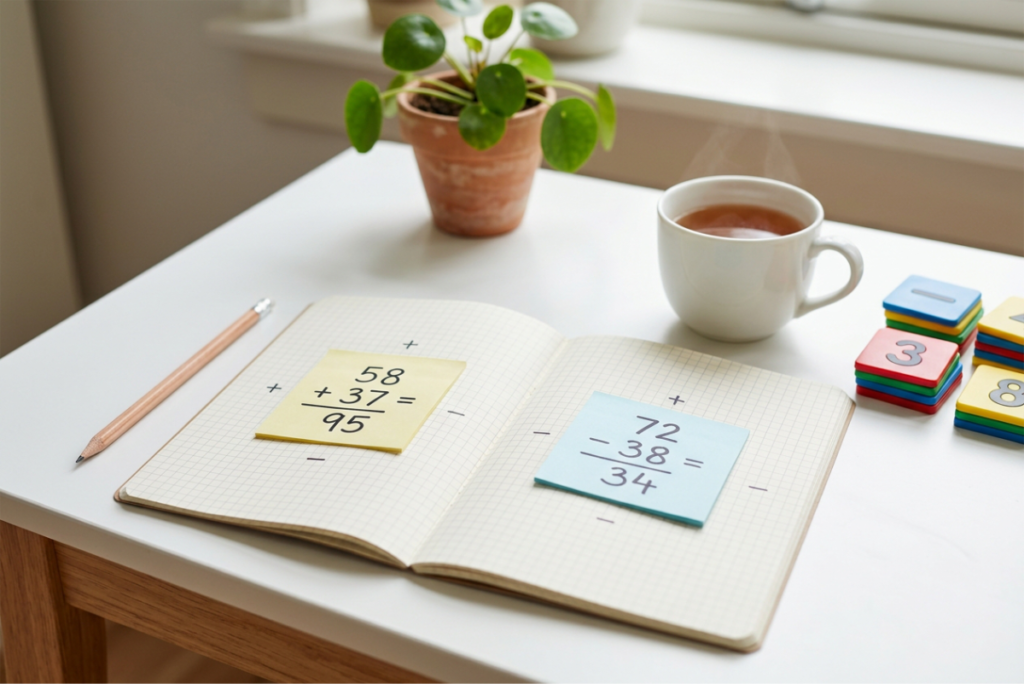
Adding and subtracting in your head is the base of all mental math. The good news is that you don’t do it the way you learned on paper. In your head, a few different methods are much easier, and each one takes only a couple of steps.
Below are seven methods with worked examples. Try each one on a few numbers of your own before moving on to the next.
1. Add Left to Right
On paper you start with the units. In your head, start with the biggest part instead. You hear the answer take shape, and the numbers stay small.
- 58 + 37: 58 + 30 = 88, then 88 + 7 = 95
- 246 + 135: 246 + 100 = 346, then + 30 = 376, then + 5 = 381
2. Make a Ten (or a Round Number)
Take a small amount from one number to bring the other up to a round number, then add what’s left.
- 47 + 38: take 3 from 38 to make 47 + 3 = 50, then 50 + 35 = 85
- 68 + 27: take 2 from 27 to make 70, then 70 + 25 = 95
- 8 + 7: take 2 from 7 to make 10, then 10 + 5 = 15
3. Use Near Doubles
Most people remember doubles easily (6 + 6 = 12, 35 + 35 = 70). If the two numbers are close, use a double and adjust by the difference.
- 6 + 7: 6 + 6 = 12, plus 1 = 13
- 35 + 36: 35 + 35 = 70, plus 1 = 71
- 48 + 50: 50 + 50 = 100, minus 2 = 98
4. Round and Adjust
When a number is just under a round number, round it up, add, and then take the extra back off.
- 57 + 99: 57 + 100 = 157, minus 1 = 156
- 86 + 38: 86 + 40 = 126, minus 2 = 124
- 150 + 198: 150 + 200 = 350, minus 2 = 348
5. Subtract by Rounding Up
Subtract a round number first, then add back the difference.
- 72 − 38: 72 − 40 = 32, then add back 2 = 34
- 152 − 98: 152 − 100 = 52, then add back 2 = 54
6. Count Up Instead of Taking Away
Subtraction is just the gap between two numbers. When the numbers are close, or you are borrowing a lot, it is easier to count up from the smaller one.
- 91 − 67: from 67 up to 70 is 3, up to 90 is 20, up to 91 is 1. Total gap: 3 + 20 + 1 = 24
- 500 − 273: from 273 up to 300 is 27, up to 500 is 200. Total gap: 227
This is how cashiers have long given change, and it works well for any subtraction from a round number.
7. Keep the Gap the Same
You can add or subtract the same amount from both numbers and the difference stays the same. Use it to turn an awkward number into a round one.
- 82 − 49: add 1 to both to get 83 − 50 = 33
- 203 − 98: add 2 to both to get 205 − 100 = 105
Which Method Should You Use?
There is no single best method. Look at the numbers first:
- If one number is close to a round number (like 98 or 199), round and adjust.
- If the numbers are close together in a subtraction, count up.
- If the numbers are awkward, add left to right, splitting into tens and units.
Choosing quickly gets easier with practice. See also our 10 mental math tricks for multiplication and percentage shortcuts.
Check Your Answer
A quick check saves mistakes. For subtraction, add the answer back: 72 − 38 = 34, and 34 + 38 = 72. For addition, estimate first by rounding: 58 + 37 is about 60 + 40 = 100, so 95 is reasonable.
Practice Plan for Beginners
- Week 1: Add left to right and make a ten, using two-digit numbers.
- Week 2: Add round and adjust, then subtract by rounding up and counting up.
- Week 3: Move to three-digit numbers and mix all the methods.
Keep sessions short. Five to ten minutes a day beats a long session once a week, and our simple daily mental math routine shows how to build it into your day. More starter ideas are in mental math exercises for beginners.
Practice Adding and Subtracting With PureMath
PureMath is a mental math trainer with short exercises in addition, subtraction, multiplication and division. You can practice one operation at a time or mix them, and difficulty increases as you improve. Progress tracking and daily streaks help you keep going.
Download PureMath on the App Store or try the mental math practice page.
Frequently Asked Questions
What is the fastest way to add in your head?
For most people it is adding left to right, with a round number where possible. Start with the tens or hundreds, then add the units.
How can I subtract in my head without borrowing?
Count up from the smaller number to the larger one, or subtract a round number and add back the difference. Neither method needs borrowing.
How can I get better at mental addition and subtraction?
Learn one method at a time, practice for a few minutes every day, and keep the difficulty just above your comfort level. Check your answers by estimating or by working backwards.
Is it OK to use my fingers?
Yes, when you are starting out. Fingers are fine for small numbers. The methods above gradually replace them as you learn to see numbers in tens.
Final Thoughts
Mental addition and subtraction come down to a few habits: work left to right, build round numbers, and count up when it’s easier. Practice a little each day and these steps will soon happen without thinking.