
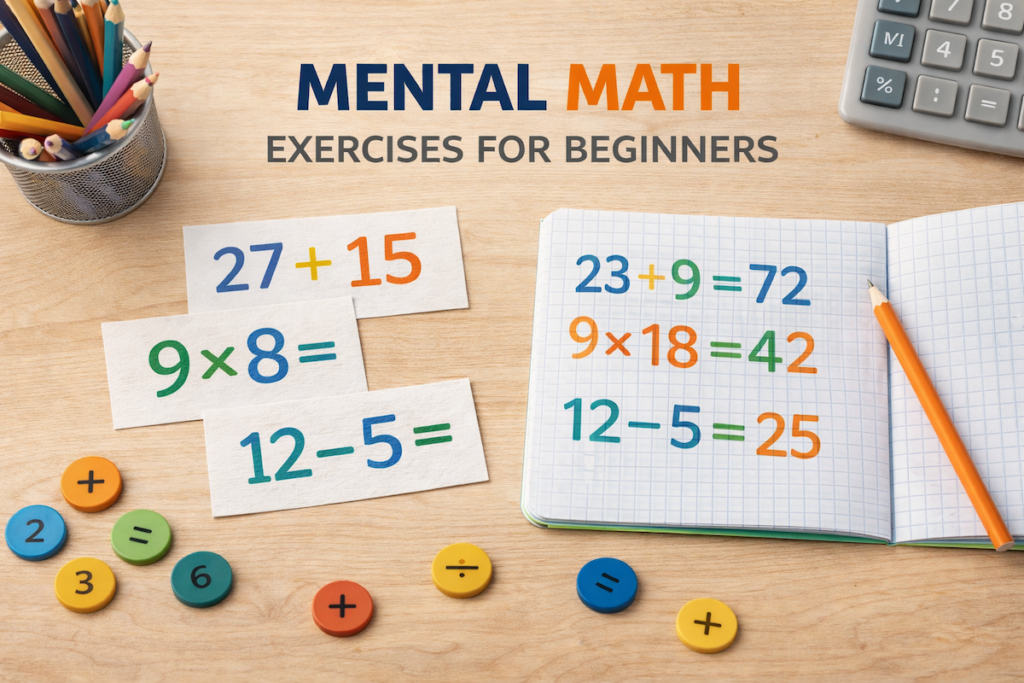
Mental Math Exercises for Beginners
If you’re just starting out, mental math can feel challenging at first. But with the right exercises and a bit of daily practice, you can quickly improve your speed and accuracy.
The key is to keep things simple and consistent. You don’t need long study sessions — just a few minutes a day can make a big difference over time.
Start With Simple Addition and Subtraction
The best way to begin is with basic addition and subtraction. These are the building blocks for all mental math.
Start with small numbers and focus on doing the calculations in your head without writing anything down. As you get more comfortable, you can increase the difficulty.
Break Numbers Into Smaller Parts
One of the easiest techniques is to break numbers into smaller parts. For example:
27 + 15 can be split into 27 + 10 = 37, then 37 + 5 = 42.
This makes calculations easier and faster, especially when dealing with larger numbers.
Practice Multiplication Step by Step
Multiplication becomes easier when you already know your tables. Start with simple ones like 2, 5, and 10, then move to harder ones.
If you need help, you can combine this with mental math practice sessions focused on multiplication.
Use Timed Exercises
Once you feel comfortable, try adding a time limit. This helps improve your speed and focus.
For example, solve as many problems as you can in one minute. Over time, you’ll notice that your speed naturally improves.
Mix Different Types of Problems
Instead of practicing only one type of operation, try mixing addition, subtraction, multiplication, and division.
This trains your brain to switch quickly between different types of problems and improves overall mental flexibility.
Practice a Little Every Day
Consistency is more important than intensity. Practicing for just 5 minutes a day is better than long sessions once in a while.
Using a mental math trainer can help you stay consistent and gradually increase difficulty as you improve.
Track Your Progress
Seeing your improvement is motivating. Try to track how fast you solve problems or how many correct answers you get.
Over time, you’ll notice that you’re solving problems faster and with fewer mistakes.
Final Thoughts
Mental math is a skill that anyone can learn. Starting with simple exercises and practicing regularly will help you build confidence and improve your abilities step by step.
Stick with it, keep your sessions short, and focus on steady progress. The results will come faster than you expect.