
Mental math is not about being a “numbers person”. It is mostly about knowing a handful of shortcuts and using them often. The tricks below turn hard-looking calculations into two or three easy steps, and every one comes with a worked example you can try right now.
You don’t need to learn all ten at once. Pick one or two, use them for a few days, then add more.
1. Multiply by 5: Halve, Then Multiply by 10
Multiplying by 5 is the same as multiplying by 10 and then halving. It is usually easier to halve first.
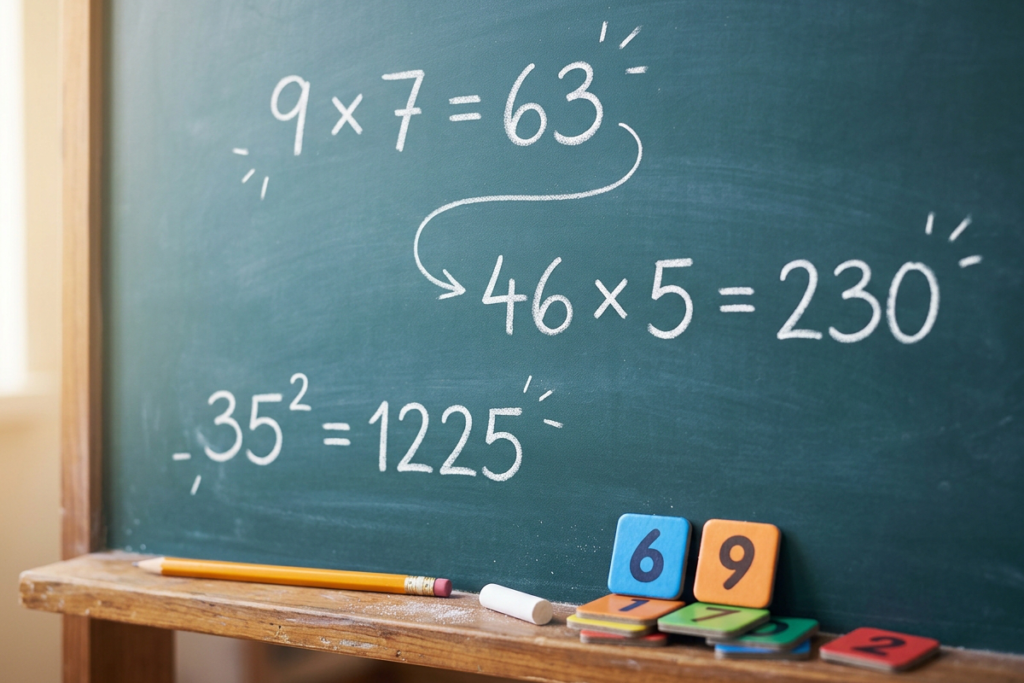
- 46 × 5: half of 46 is 23, so the answer is 230
- 38 × 5: half of 38 is 19, so the answer is 190
If the number is odd, halve it anyway and keep the .5: 7 × 5 → 3.5 × 10 = 35.
2. Multiply by 9: Multiply by 10, Then Subtract
Since 9 is one less than 10, you can multiply by 10 and subtract the number once.
- 9 × 7: 70 − 7 = 63
- 9 × 34: 340 − 34 = 306
A bonus check: the digits of any answer in the 9 times table add up to 9 (18 → 1 + 8, 27 → 2 + 7, 36 → 3 + 6).
3. Multiply a Two-Digit Number by 11
Write the two digits with their sum in the middle.
- 34 × 11: 3, then 3 + 4 = 7, then 4, giving 374
- 62 × 11: 6, then 6 + 2 = 8, then 2, giving 682
When the middle sum is 10 or more, carry the 1 to the left digit. For 78 × 11: the middle is 7 + 8 = 15, so write 7, 5, 8 and carry the 1 to get 858.
4. Square Numbers That End in 5
Take the digit(s) before the 5, multiply by the next number up, and add 25 on the end.
- 35²: 3 × 4 = 12, so the answer is 1225
- 75²: 7 × 8 = 56, so the answer is 5625
- 15²: 1 × 2 = 2, so the answer is 225
5. Break Numbers Into Parts
This is the most useful trick of all. Split one number into tens and units, solve each piece, then add them together.
- 47 × 6: (40 × 6) + (7 × 6) = 240 + 42 = 282
- 23 × 8: (20 × 8) + (3 × 8) = 160 + 24 = 184
It works for addition too. We cover this idea more in our guide to mental math exercises for beginners.
6. Round and Adjust
When a number is close to a round one, use the round number and correct the difference afterwards.
- 49 × 6: 50 × 6 = 300, then subtract 6, giving 294
- 199 + 87: 200 + 87 = 287, then subtract 1, giving 286
- 31 × 4: 30 × 4 = 120, then add 4, giving 124
7. Double and Halve
In a multiplication, you can double one number and halve the other without changing the answer. This is handy for numbers like 25 and 50.
- 16 × 25: 8 × 50 = 4 × 100 = 400
- 14 × 35: 7 × 70 = 490
8. Add Left to Right
On paper we add right to left. In your head it is easier to start with the biggest part, because you hear the answer taking shape.
- 58 + 37: 58 + 30 = 88, then 88 + 7 = 95
- 246 + 135: 246 + 100 = 346, then + 30 = 376, then + 5 = 381
9. Subtract by Rounding Up
Subtraction is easier when you take away a round number and then fix the difference.
- 83 − 47: 83 − 50 = 33, then add back 3, giving 36
- 152 − 98: 152 − 100 = 52, then add back 2, giving 54
10. Find 10% First for Percentages
Ten percent is just the number with one decimal place moved. From there you can build almost any percentage.
- 10% of 80 = 8
- 5% of 80 = half of 10% = 4
- 15% of 80 = 8 + 4 = 12
- 20% of 80 = 8 × 2 = 16
This is useful for tips, discounts and sales tax.
How to Make These Tricks Stick
Reading a trick once will not make it automatic. The shortcuts become natural only after repetition.
- Learn one at a time. Use a single trick for several days before adding another.
- Practice in short sessions. Five to ten minutes a day works better than one long session. Our simple daily mental math routine shows how to fit it in.
- Know your times tables. Most tricks rely on quick recall of basic facts. If yours need work, see how to learn multiplication tables fast.
- Check your answers. Estimate first, then compare. If 49 × 6 should be close to 300, an answer of 249 is clearly wrong.
For a wider set of habits beyond tricks, read our tips on how to improve mental math skills fast.
Practice These Tricks With PureMath
PureMath is a mental math trainer with short exercises in addition, subtraction, multiplication and division, either one at a time or mixed. Difficulty increases as you improve, and you can track your progress and keep a daily streak going. It is a simple way to turn these tricks into habits.
Download PureMath on the App Store or try the mental math practice page.
Frequently Asked Questions
What is the easiest mental math trick for beginners?
Breaking numbers into parts (trick 5) is the easiest to start with, because it uses only multiplication facts you already know. Multiplying by 5 by halving (trick 1) is a close second.
How long does it take to get good at mental math tricks?
Most people can use a new trick comfortably after a week of short daily practice. Becoming fast and automatic across several tricks usually takes a few weeks.
Do mental math tricks work for adults?
Yes. They are useful at any age, for everyday tasks such as shopping, splitting bills, calculating tips and checking totals.
Should I learn the tricks or just practice?
Both. Tricks give you a method, and practice makes the method fast. Learn a trick, then use it in short daily sessions until you no longer have to think about the steps.
Final Thoughts
Mental math tricks are shortcuts, not magic. Learn a few, practice them regularly, and calculations that once looked hard will start to feel easy.