
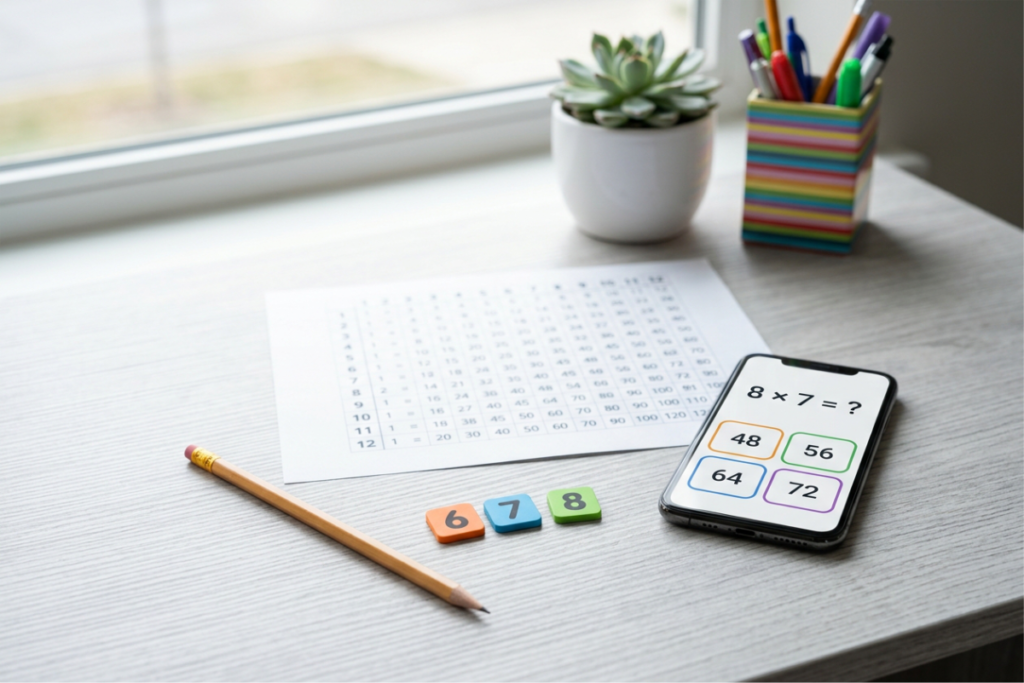
Here is a complete times tables chart from 1 to 12, followed by simple tips for learning each table. Use the chart to look up an answer, then use the tips and the practice plan to remember it without looking.
Multiplication Chart 1–12
To find an answer, pick a number in the left column and a number in the top row. The answer is where they meet. For example, 7 × 8 = 56.
| × | 1 | 2 | 3 | 4 | 5 | 6 | 7 | 8 | 9 | 10 | 11 | 12 |
|---|---|---|---|---|---|---|---|---|---|---|---|---|
| 1 | 1 | 2 | 3 | 4 | 5 | 6 | 7 | 8 | 9 | 10 | 11 | 12 |
| 2 | 2 | 4 | 6 | 8 | 10 | 12 | 14 | 16 | 18 | 20 | 22 | 24 |
| 3 | 3 | 6 | 9 | 12 | 15 | 18 | 21 | 24 | 27 | 30 | 33 | 36 |
| 4 | 4 | 8 | 12 | 16 | 20 | 24 | 28 | 32 | 36 | 40 | 44 | 48 |
| 5 | 5 | 10 | 15 | 20 | 25 | 30 | 35 | 40 | 45 | 50 | 55 | 60 |
| 6 | 6 | 12 | 18 | 24 | 30 | 36 | 42 | 48 | 54 | 60 | 66 | 72 |
| 7 | 7 | 14 | 21 | 28 | 35 | 42 | 49 | 56 | 63 | 70 | 77 | 84 |
| 8 | 8 | 16 | 24 | 32 | 40 | 48 | 56 | 64 | 72 | 80 | 88 | 96 |
| 9 | 9 | 18 | 27 | 36 | 45 | 54 | 63 | 72 | 81 | 90 | 99 | 108 |
| 10 | 10 | 20 | 30 | 40 | 50 | 60 | 70 | 80 | 90 | 100 | 110 | 120 |
| 11 | 11 | 22 | 33 | 44 | 55 | 66 | 77 | 88 | 99 | 110 | 121 | 132 |
| 12 | 12 | 24 | 36 | 48 | 60 | 72 | 84 | 96 | 108 | 120 | 132 | 144 |
The Chart Is Smaller Than It Looks
It has 144 squares, but you don’t need to learn them all. Multiplication works in either order, so 3 × 7 and 7 × 3 are the same fact. That cuts the chart roughly in half. Take away the easy 1, 2, 5, 10 and 11 tables, and only a few dozen facts remain.
Tips for Each Times Table
1 Times Table
Any number times 1 stays the same.
2 Times Table
Double the number. The answers are all even: 2, 4, 6, 8, 10, 12 and so on.
3 Times Table
Double the number and add one more of it: 3 × 7 is 14 + 7 = 21. The digits of each answer add up to 3, 6 or 9 (21 → 2 + 1 = 3, 27 → 2 + 7 = 9).
4 Times Table
Double, then double again. 4 × 6 is 6 doubled to 12, doubled to 24.
5 Times Table
The answers always end in 0 or 5. Half the number times 10 also works: 5 × 8 is half of 80, which is 40.
6 Times Table
Multiply by 5 and add one more of the number: 6 × 7 is 35 + 7 = 42. When you multiply 6 by an even number up to 10, the answer ends in that number (6 × 4 = 24, 6 × 8 = 48).
7 Times Table
This is the hardest table for most people. Use 5 and 2: 7 × 6 is 30 + 12 = 42. For 7 × 8 = 56, remember the sequence 5, 6, 7, 8.
8 Times Table
Double three times: 8 × 3 is 3 → 6 → 12 → 24. The last digits count down by 2: 8, 6, 4, 2, 0 (8, 16, 24, 32, 40).
9 Times Table
Multiply by 10 and subtract the number: 9 × 7 is 70 − 7 = 63. The digits of each answer add up to 9, and the tens digit goes up while the units digit goes down (09, 18, 27, 36, 45, 54, 63, 72, 81, 90).
10 Times Table
Add a zero to the end of the number.
11 Times Table
Up to 9 × 11, repeat the digit: 11, 22, 33 … 99. For 11 × 12, use 12 × 10 + 12 = 132.
12 Times Table
Multiply by 10 and add double the number: 12 × 7 is 70 + 14 = 84.
The Hardest Times Table Facts
Most learners find the same handful of facts hardest. Once you know the easy tables, these are the ones that need extra attention:
- 6 × 7 = 42
- 6 × 8 = 48
- 6 × 9 = 54
- 7 × 7 = 49
- 7 × 8 = 56
- 7 × 9 = 63
- 8 × 8 = 64
- 8 × 9 = 72
- 12 × 12 = 144
Write them on a card and test yourself on these nine each day. Because they are only a few facts, they respond quickly to short, focused practice.
What Order Should You Learn Them In?
- 2, 5 and 10
- 3 and 4
- 9 and 11
- 6 and 8
- 7 and 12
Each step uses facts you already know, so you are never starting from zero. For more ways to speed up, read how to learn multiplication tables fast.
How to Practice So the Facts Stick
- Test yourself, don’t just read the chart. Cover the answers and try to recall them.
- Practice a little every day. Five to ten minutes beats a long session once a week. See our simple daily mental math routine.
- Revisit mistakes. Spend most of your time on the facts you miss, not the ones you know.
- Use the facts in real calculations. Our mental math tricks put them to work.
- Make it a game. Kids, in particular, enjoy math games for practice.
Practice Your Times Tables With PureMath
PureMath is a mental math trainer with focused times tables practice. You can train multiplication on its own or mixed with other operations, and see your speed and accuracy over time. Reminders and a streak calendar help you practice a little each day.
Download PureMath on the App Store or try the mental math practice page.
Frequently Asked Questions
How many multiplication facts do I need to learn?
The full 12 × 12 chart has 144 squares, but because the order doesn’t matter and the 1, 2, 5, 10 and 11 tables are easy, most learners focus on a few dozen facts.
What is the hardest times table?
Most people find the 7 times table hardest, followed by 6 and 8. The nine facts listed above cause the most trouble.
What age should kids know their times tables?
It varies by school and country. Many children start in the early primary years and aim to know the tables up to 12 by around age 9 or 10, but check your own curriculum.
Is there a trick for the 9 times table?
Yes. Multiply by 10 and subtract the number (9 × 6 = 60 − 6 = 54). You can also check that the digits of the answer add up to 9.
Final Thoughts
A times tables chart is a good reference, but memory comes from practice. Learn the tables in a sensible order, focus on the few hard facts, and test yourself a little every day.