
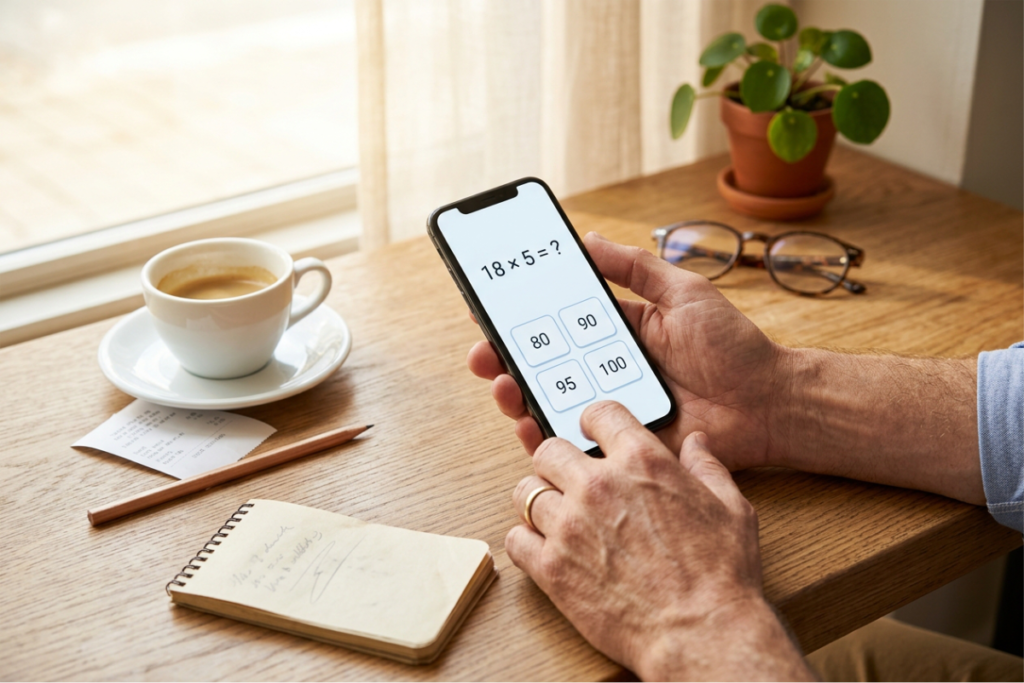
If you reach for your phone calculator every time you need to work out a tip or a discount, you are not alone. Most adults haven’t practiced mental math since school. The skill fades with disuse, but it comes back, and often faster than people expect.
This guide covers a practical plan for adults: find your gaps, learn a few shortcuts, and practice in small daily sessions.
Why Mental Math Feels Hard as an Adult
There are usually three reasons, and none of them is a lack of ability:
- Lack of practice. Calculators and phones do the work, so the skill isn’t used.
- Gaps in the basics. Slow recall of a few multiplication facts makes every bigger calculation slow.
- Math anxiety. Many adults carry a bad memory of timed tests, which makes them tense up when numbers appear.
Each of these can be fixed with the steps below.
Step 1: Find Out Where You Stand
Spend two minutes on a few problems from each area: adding two-digit numbers, subtracting from 100, multiplication facts up to 12 × 12, and simple division. Notice which feel slow. That’s what to work on first, so you are not wasting time on things you already know.
Step 2: Fill the Gaps in Your Basic Facts
Quick recall of multiplication facts is the biggest single speed-up. If you hesitate on 7 × 8 or 6 × 9, other calculations will always feel slow. Use our times tables chart to find your weak spots, then spend a few minutes a day on them. The guide to learning multiplication tables fast has methods for each table.
Step 3: Learn a Few Shortcuts
You don’t need to be a human calculator. A few methods cover most everyday situations:
- Split numbers into parts. 47 × 6 = (40 × 6) + (7 × 6) = 240 + 42 = 282
- Round and adjust. 49 × 6 = 50 × 6 − 6 = 294
- Add left to right. 58 + 37 = 58 + 30 + 7 = 95
- Count up to subtract. 91 − 67: 67 to 70 is 3, to 90 is 20, to 91 is 1, so the answer is 24
See 10 mental math tricks and how to add and subtract in your head for more worked examples.
Step 4: Practice a Little Every Day
Short, regular sessions work better than occasional long ones. Aim for five to ten minutes a day at a time that fits your routine, such as with your morning coffee or on your commute. If you’re not sure how to structure it, follow the simple daily mental math routine.
Keep each session slightly challenging. If everything is easy, make it harder. If you are guessing, go back a level.
Step 5: Use Real-Life Situations
Everyday life gives you free practice. Try doing these in your head before reaching for the calculator:
- Tips. To tip 20% on a 45 bill: 10% is 4.50, so 20% is 9.00.
- Discounts. 30% off 60: 10% is 6, so 30% is 18, and the price is 60 − 18 = 42.
- Splitting a bill. 126 split four ways: 120 ÷ 4 = 30, plus 6 ÷ 4 = 1.5, so 31.50 each.
- Estimating a shop. Three items at 4.95: round to 5, so 3 × 5 = 15, minus a few cents, so about 14.85.
- Time and distance. A 90 km trip at 60 km/h takes one and a half hours.
Do your mental calculation first, then check it on your phone. The check gives you instant feedback.
Step 6: Estimate First
Estimating is a skill in its own right. Round the numbers, work out a rough answer, and use it to judge any precise answer you find later. If 38 × 21 is roughly 40 × 20 = 800, then an answer of 98 or 8,000 is clearly wrong.
Step 7: Deal With Math Anxiety
- Start with problems that are easy enough to get right, and build up slowly.
- Practice without a time limit at first. Add timing later.
- Treat mistakes as information about what to practice, not as failure.
- Keep sessions short, so they never feel like a chore.
Step 8: Track Your Progress
Progress in mental math is easy to miss day to day. Writing down your speed and accuracy each week shows how far you have come, which keeps you motivated. Many people also find that keeping a daily streak helps them stay consistent.
A Simple 4-Week Plan for Adults
- Week 1: Check your basics and fill gaps in multiplication facts.
- Week 2: Learn left-to-right addition and rounding for subtraction.
- Week 3: Add multiplication shortcuts and use them in everyday situations.
- Week 4: Mix all four operations and begin light timing.
For more habits that build speed, read how to improve mental math skills fast.
Train With PureMath
PureMath is a mental math trainer built for short daily sessions. It covers addition, subtraction, multiplication and division, one at a time or mixed, with difficulty that increases as you improve. It also includes times tables practice, memory games, progress tracking, reminders and a streak calendar. It is designed for different ages and skill levels, including adults.
Download PureMath on the App Store or try the mental math practice page.
Frequently Asked Questions
Can adults improve at mental math?
Yes. Mental math is a skill built through practice, not a fixed talent. Adults who practice for a few minutes a day typically notice improvement within a few weeks.
How long does it take to get faster?
It depends on where you start and how often you practice. Many people notice that everyday calculations feel easier after two to four weeks of short daily sessions.
Should I stop using a calculator?
No. A calculator is the right tool for long or exact calculations. Mental math is for the many everyday cases where a quick, good answer is enough, and for checking that a calculator result makes sense.
What should I practice first?
Start with the multiplication facts you hesitate on, then learn left-to-right addition. These two changes give the biggest improvement for the least effort.
Final Thoughts
Getting faster at mental math as an adult is mostly about habit. Fix the basics, learn a few shortcuts, use them in daily life, and practice a little each day. The skill comes back sooner than you might think.